Published on Sampan, 05. 22. 2015
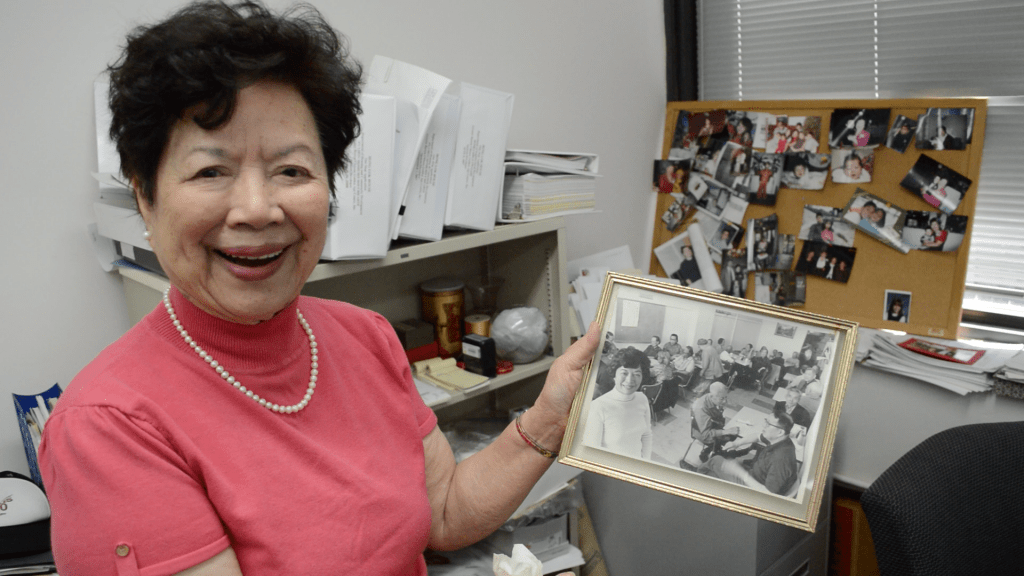
On a sunny, windy October afternoon, Ruth Moy heads towards a throng of city officials gathering on the construction site of Parcel 24, at Boston’s Chinatown gateway. She cuts a colorful figure, in Persian rose pink, glowing as she moves through a tableau of people in black suits.
Moy schmoozes with city Commissioner of Elderly Affairs Emily Shea as she walks through the crowd. She smiles and chats with old friends, as she has for forty years.
Unlike some of those times, today she keeps her talk light and easy. Her often frustrating seven-year effort to raise funds to expand the Hong Lok House and its senior housing has ended.
Since its original 28 units opened to Chinatown in the 1970s, a whirlwind of change has encompassed the neighborhood. Big players have come and gone, federal policy has shifted, high rises have replaced strip joints as the neighborhood’s biggest threat. Yet Hong Lok has grown painstakingly into 72 units, the centerpiece, in a way, of Moy’s life work.
Forty years ago, when the state offered her HUD funds to purchase the first Hong Lok House, she had to fight the bar rooms and strip clubs nearby in what was known as Boston’s Combat Zone on the streets, in city hall, and in the courtrooms.
At the turn of the new century, luxury apartments like Archstone and Kensington began gobbling up Chinatown’s land, putting pressure on the small neighborhood’s rents and hiking the demand for affordable housing more than ever.
Moy raised and allocated funds from 13 foundations to expand Hong Lok, despite federal cuts in affordable housing funds. She also pressured some of the new landlords, like Archstone, to fulfill promises at two buildings on Essex Street.
Now, with all that behind her, Moy sits in the front row of today’s gathering, quietly listening to the new mayor’s progressive affordable housing plan — and his promise to build 5000 more senior housing units by 2030. There’s a smile on her face.
************
Shortly after her birth, at the start of the Great Depression, Moy’s family moved back to China to the coastal village of Taishan. She recalls little of this time except that the village had no electricity and began school there.
************
Shortly after her birth, at the start of the Great Depression, Moy’s family moved back to China to the coastal village of Taishan. She recalls little of this time except that the village had no electricity and began school there.
(The Moy’s migration between the Great Depression and the second Sino-Japanese War)
When she returned to Massachusetts during elementary school, her family settled in Fall River, Massachusetts. This time, the land of promise proved just that.
Within 20 years, she had met her husband and married. The couple opened a chain of three restaurants, all called Cathy Inn. One was in Needham, another on Cape Cod.
In the late ’60s, Moy joined 27 other young professional suburban Chinese men and women to form the Chinese American Civic Association, which has since split into a variety of Chinatown organizations. The civic association’s goal was to seek state and federal funds for Chinatown.
“The goal was to fight for rights for Chinese people to mainstream during the Urban Renewal time,” says Amy Guen, former director of South Cove Manor Nursing and Rehabilitation Center in Quincy, Massachusetts.
Moy earned a real estate broker’s license, worked at a law firm. In 1971, fluency in English, Taishanese and Cantonese proved particularly valuable credentials among volunteers in Chinatown.
Back then, Oxford Street and Harrison Street marked the primary boundaries of the community’s turf, Cantonese was the language of choice and the Chinese community was still from the world of Boston outside the neighborhood’s borders.
More affluent adults and better-educated kids moved elsewhere. The bachelors who had lived in the United States through the bitter years of the Chinese Exclusion Act were growing old. And the neighborhood lacked services to bind it together as one.
Lili Mei, the director of Golden Age Center’s Brighton branch and Moy’s relative, said that Moy began to build bridges between the community and the city.
As an avid detective novel reader, Moy also found passion in solving real-life problems. Her husband died soon after she joined the Golden Age Center, 1971, leaving her behind to juggle three jobs and four teenage children. Things would only got more hectic from there.
************
When Moy began her work in Chinatown, it was home to the infamous Combat Zone, a place of bars and strip clubs, drunks and drugs.
During the 1970s, as the Combat Zone reached its heyday in Chinatown, the Golden Age Center under Moy’s leadership bought the original Hong Lok House on Essex Street and converted it to elderly housing.
But there were problems. The people of Chinatown could hear the shootings on nearby lower Washington Street, then a dirt road lit up in the nights by the bars and strip clubs.
Few people wanted to live in the new complex. The Combat Zone had moved onto lower Washington Street between Boylston and Kneeland Street in the 1960s because of urban renewal. Essex Street was within that perimeter.
Isadore Ort owned the original Hong Lok House property. He opened a bar and grill called Izzy Ort’s there during the World War II. But an Italian gang member rented the property and converted it to the Normandy Lounge.
Moy recalled that one day, the original owner’s relative, a lawyer she remembers simply as Mr. Fox, called a Florida number to complain that no one had paid the rent.
“If you don’t pay the rent, I’m gonna sue you,” the lawyer told whomever answered the phone. A few days later, the tenant called back. “If you sue me. I’m gonna kill you,” he said. The landlord said, “Well never mind.”
But the tenant didn’t return and a few years later Moy was able to convert the building from a nightclub to apartments for the elderly. At that time, The Naked I, one of the four major strip clubs in the neighborhood, was around the corner.
Moy met often with Peggy Ings, vice president of Government and Community Relations for Emerson College and a member of the Neighborhood Task Force Committee, to talk about how to push out the Combat Zone. Together the two women fought to revoke the bar room and strip club’s licenses, a process that took four years.
Moy played a big role in rallying the neighborhood against the expansion of another club, the Glass Slipper, Ings recalls. “We picketed in the night time and it was freezing, it was snowing and raining, and Ruth was right there, leading the charge,” Ings said. “She brought people with her.” The protesters marched in a circle up and down Lagrange Street, shouting to people entering, “no expansion. no expansion.” Eventually, Moy won.
Next, Moy bussed Chinatown seniors to city hall to testify in an effort to keep the Fox Lady club from entering the neighborhood. She learned how to investigate the club owners’ records quickly and raised money to hire lawyers.
The thing that Moy and other activists couldn’t do was to change the zoning for the entertainment district. In the end, they also didn’t find anything to use against the club,Centerfolds, which exists to this day. But the neighborhood was getting better.
In 1981, 21 elderly units opened at Hong Lok House. Often Moy was in the center of things, recalls Lili Mei. ” Seven years ago, the rain flooded the basement of old Hong Lok house,” she recalls. “[Moy] went there three to four o’clock in the morning busily supervising for the whole night.”
Moy often tells people who complain to her about the neighborhood to establish something of value there. “I want to expand the boundaries of Chinatown, by taking that, and making it Chinese.,” she says. “We push, and we expand. You do that by buying properties, and running businesses. Take over another street. You have to expand by ownership.”
She personally owns 10 apartments in Boston, which she rents. Moy has overseen other changes. The Golden Age Center, which Moy still runs, also has expanded its new day care programs to three sites, since its humble start as a meal serving spot on Pine Street in 1972.
Today, it sends out more than 2,000 free meals to families each day, nearly 100 times more than the 24 meals it began with in 1971. Moy also sent her staff out to Cambridge, Brookline, Quincy, Framingham, Lexington and Malden, other centers where Chinese immigrants have settled.
Amy Guen, former director of South Cove Manor Nursing and Rehabilitation Center in Quincy, Massachusetts, says Moy has built effective day care programs throughout the area.
“Those people who go to her day care service really enjoyed it,” she says. “If they didn’t have a Chinese one they would have to go to an American one. Some people refuse to go.”
Mei says, “It was unbelievable that [Moy] expanded the programs into what they are today. She knows how to seize the opportunity to develop new things. She is not the type that would stick in the mud.”
At 86, Ruth Moy is still developing new things.
***********
The Empire Garden Restaurant stands today in place of the Pilgrim Theatre, a strip club that once stood there. Its giant cloud mural dome now looks down on weekends on a full hall of Chinese-American seniors who dine there on dim sum. Across the street, residents of Kensington, soak in the rooftop pool overseeing the city, from near the top of the 27-story luxury glass building.
Moy initially teamed with the developers of Chinatown’s new residential towers to clean up the streets of the Combat Zone. The Kensington tower, built in 2013, forced out the Glass Slipper, one of the last two remaining strip clubs in Chinatown.
Unlike some other community voices, who feared the gentrification of the neighborhood, Moy supported Kensington. The luxury apartment developments contributed $7 million to the community.
But cooperating with the big companies has taken Moy through twists and turns as well. Her deal with Archstone Smith, for example, to build affordable units and contribute to the neighborhood came up short three times over five years.
Since 2010, nine luxury buildings that charge full market rates only have been built on the perimeter of Chinatown. In contrast, just five apartment buildings that have some affordable units have been added to a community with the city’s lowest annual family income at $14,000.
With this new wave of gentrification has come an influx of affluent whites and the exodus of Chinatown’s youngsters and families. The population of whites in Chinatown doubled in the decade beginning in 2000. Other buyers are new, wealthier immigrants from Asia.
Drug crimes remain in Chinatown, yet its real estate is booming. But Ruth Moy continues to fight for those who for decades or generations have called the neighborhood home. Her latest contribution has been the expansion of subsidized housing at Hong Lok House. It took seven years, $36 million, and 23 funding sources.
As Moy worked to put together the funding and approvals, she showed both the determination and patience that have marked all her battles.
“She worked hard,” says Bill Moy (not a relative), the chairman of the Chinatown Neighborhood Council. “They went to all the foundations that they could. She’s got maybe a million here, a million there, a hundred thousand dollars here and there. It’s not all large grants. She had to wait in a lot of lines for her project to a point that an organization could fund them.”
Such persistence can rub some people the wrong way, he said. But, he adds, it also gets things done. That’s Ruth Moy. “Ruth Moy is a very tough person to deal with,” he says. “She wouldn’t leave anything on the table. But she has used that for the dedication of Chinatown.”
Moy’s new Hong Lok House is slated to be finished this month. All the funds are allocated, and all the units have already been booked. But she is looking ahead, not behind. With Mayor Walsh’s newly announced housing plan for 2030, another 53,000 units are planned for the city, including 5,000 senior units.
Moy said, “It will be interesting to see what the city will do to build more affordable housing, because it took us so long to build Hong Lok already.” Later she added, “I don’t think anyone can afford not having it done. The city needs it. The mayor was talking about that. I hope that the city is going to build more housing.”
 Pro Bono Journalism
留下评论